
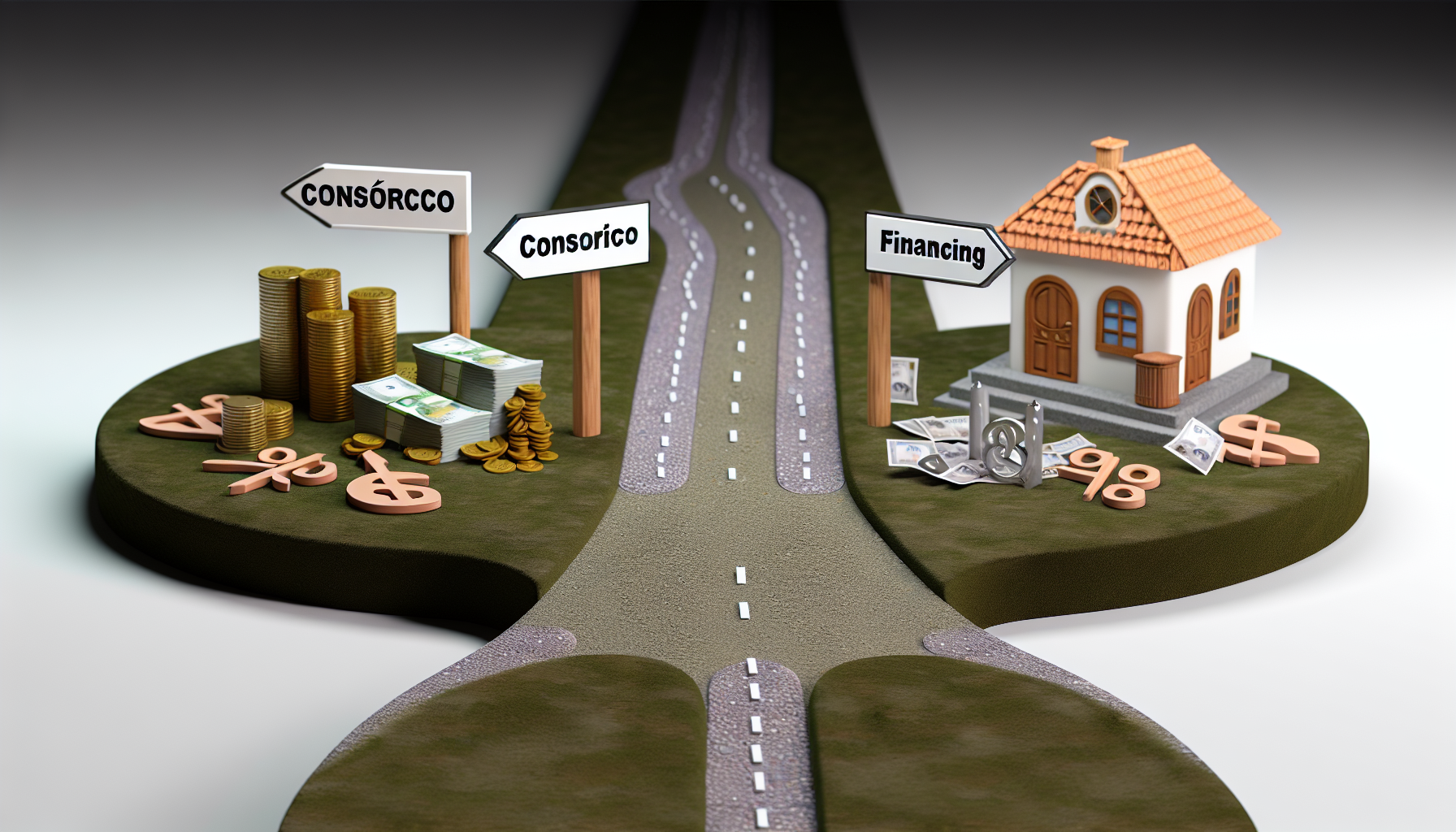
When faced with big-ticket purchases like property or vehicles, individuals often waver between consórcio (a Brazilian group savings scheme) and financing options. This article delves deeply into each choice, comparing their intricacies to guide you towards the most financially savvy decision.
Understanding Consórcio
Understanding Consórcio
A consórcio is a financial arrangement unique to Brazil, rooted in its culture and economic practices since its inception in the 1960s. It presents a distinctive approach to acquiring high-value items, like cars, houses, and other costly goods or services, relying on a group savings scheme rather than direct financing or loans. This method emphasizes collective effort and patience, offering both benefits and constraints to its participants.
The fundamental principle of a consórcio is straightforward: a group of individuals pools their resources to fund a collective pot, from which members can finance their purchases. Each participant makes monthly contributions, the total of which allows for the purchase of the desired item by one or more members, depending on the group’s size and the total funds collected.
Membership in a consórcio hinges on a dual system of allocation: a lottery and a bidding process. The lottery is a game of chance, with no additional cost to participate, making it a fair and unbiased method for determining who among the group gets to utilize the pooled funds each month. In contrast, the bidding process allows members who are willing and able to contribute more than their standard monthly payment to secure earlier access to the fund for their purchase. This system introduces a layer of strategy and flexibility, catering to those with varying financial capabilities and needs.
The benefits of participating in a consórcio include the absence of interest rates, which starkly contrasts with traditional financing methods and can lead to significant savings over time. Additionally, the collective nature of a consórcio fosters a disciplined approach to saving, as members are committed to monthly contributions towards their goal.
However, consórcios also have drawbacks, notably the uncertainty of when a member will be able to make their purchase, which can be a significant disadvantage for those requiring immediate access to goods or services. Furthermore, administrative fees are applied, and while lower than interest charges on loans, they still represent an additional cost.
Overall, a consórcio offers a communal, interest-free alternative to traditional financing, pairing the discipline of systematic saving with the excitement of a lottery, but requires patience and a long-term perspective from its participants.
The Ins and Outs of Financing
The Ins and Outs of Financing:
Financing, in contrast to a Consórcio, entails borrowing a specific amount of money from a financial institution for making large purchases, such as a home or vehicle, and agreeing to repay this amount over a stipulated period, with interest. This option can offer immediate access to the property or item one intends to buy, as opposed to waiting for a draw or accumulating enough funds within a Consórcio group.
The application process for financing typically begins with the potential borrower submitting an application to a bank or financial institution. This application will necessitate the provision of personal and financial information to assess the borrower’s creditworthiness and ability to repay the loan. Common requirements include proof of income, employment history, a positive credit report, and sometimes, collateral. The interest rates and loan terms offered to an individual will greatly depend on these assessments. Interest rates can vary widely based on the borrower’s credit score, the loan amount, and the repayment period.
Interest rates on loans are either fixed or variable. A fixed rate implies the interest rate remains constant throughout the term of the loan, while a variable rate can change based on the market conditions. The choice between these two can significantly impact monthly payments and the total amount paid over the life of the loan. Longer loan terms will generally mean lower monthly payments but can lead to a higher total payment over time due to the accumulation of interest.
It’s imperative to understand the impact financing can have on one’s financial health. While it provides immediate access to what one might need or want, financing also means committing to a fixed monthly payment that can strain the budget. This commitment requires careful planning and consideration of one’s long-term financial goals and present reality. Before choosing financing, it’s crucial to evaluate whether the monthly payments are feasible within your budget and to consider how these costs compare over time with other options like a Consórcio, especially in terms of total interest paid and administrative fees, as the following chapter will explore in detail.
Comparing Costs Over Time
In comparing the long-term costs between a Consórcio and financing, one must evaluate several financial elements that significantly affect the total expenditure over time for any considerable purchase. Unlike financing, where interest rates play a crucial role in determining the total cost, a Consórcio includes administrative fees and the chance component of when you might be awarded the goods or service.
Firstly, when considering a financing option, the total cost of a purchase is not just the principal amount borrowed but also includes the interest accrued over the loan period. These interest rates can vary widely depending on the institution, the borrower’s creditworthiness, and market conditions. Additionally, some financing options might have variable rates, which can increase the total paid over time if market rates rise. The effect of compound interest can significantly increase the total cost of a purchase, far above the original price tag.
Conversely, a Consórcio does not charge interest in the traditional sense but involves paying into a pool with other participants, with the funds being used to award the purchase to members over time. However, administrative fees are charged, which are a percentage of the total cost of the item. These fees, along with the uncertainty of when you might receive the product or service, can make it challenging to compare directly with the financing cost. The time value of money is an essential consideration here; money paid now is worth more than the same amount paid in the future due to its potential earning capacity.
To illustrate, consider a hypothetical scenario in which an individual is contemplating financing or joining a Consórcio for a $20,000 car. If they choose financing with an annual interest rate of 5% over five years, the total cost would significantly exceed the initial price once interest is factored in. In contrast, joining a Consórcio might involve a lower monthly outlay since there’s no interest, but administrative fees could amount to around 15-20% of the car’s value over the group’s life, not to mention the potential delay in actually receiving the car.
In essence, while a Consórcio can offer the advantage of no interest rates, the administrative fees and unpredictable wait times need to be carefully considered. Financing, though potentially more expensive due to interest, provides the immediacy of acquisition and fixed repayment schedules. The decision between these options should factor in one’s financial situation, risk tolerance, and the time horizon for needing the item.
Assessing Risks and Benefits
Assessing the risks and benefits of both Consórcio and financing is crucial for making an informed decision on which option suits your financial situation and needs the best. While the previous chapter analyzed the long-term costs involved in both options, here we focus on the immediate and potential long-term financial implications in terms of market volatility, payment flexibility, and acquisition opportunities.
Starting with Consórcio, one of the significant benefits is the absence of interest rates, which dramatically impacts the total cost of your purchase over time. However, it’s essential to consider the administrative fees and how they compare to interest rates charged by financing options. A notable advantage of Consórcio is the chance to acquire the property or item early if you’re drawn in the lot or if you offer a winning bid. This feature introduces an element of chance that doesn’t exist in traditional financing, where acquisition is strictly tied to the repayment schedule.
On the downside, the funds in a Consórcio are subject to market volatility. The pot of money available depends on the financial health and timely payments of all participating members. There’s also the time factor; depending on how quickly you need the item or property, Consórcio might not be the best route since you could potentially wait years before your name is drawn.
Moving to financing, the most apparent benefit is the immediate acquisition of the item or property. Financing offers a predictable payment schedule with fixed monthly repayments, which is particularly beneficial for individuals who require certainty in their financial planning. However, the stability comes at a cost, notably the interest rates which, unlike Consórcio administrative fees, can significantly increase the total amount paid over time.
Interest rate changes pose a risk for those choosing financing, especially with adjustable-rate loans where the rate can increase over time. The volatility of future interest rates can significantly affect your long-term financial commitment and planning.
In conclusion, while Consórcio offers a path potentially less costly than financing, it does not guarantee immediate acquisition and is influenced by the group’s financial behavior. Financing, while more immediate and predictable, usually ends up being more expensive due to interest rates. As we move to consider strategies for making an informed decision in the following chapter, understanding these risks and benefits fully, alongside an assessment of personal financial conditions, timelines, and market conditions, will be vital.
Strategies for Making an Informed Decision
Determining the best pathway between a Consórcio and financing for large purchases requires a nuanced understanding of one’s financial landscape, alongside strategic planning. Here, we outline strategies to assist prospective buyers in navigating these options meticulously.
Firstly, conducting a comprehensive assessment of one’s financial health is crucial. This includes analyzing cash flow, savings, debt levels, and future income stability. For individuals with a stable income and the capacity to allocate funds for monthly payments without compromising other financial obligations, financing might be a viable option. This strategy is particularly beneficial when immediate acquisition of the asset is imperative. Conversely, for those who have a more flexible timeline and aim to avoid interest rates, joining a Consórcio could prove advantageous. Since payments in a Consórcio do not incur interest – merely an administrative fee – this option is cost-effective over time for disciplined savers who can afford to wait for their turn to be allotted the asset.
Envisioning long-term financial goals is also essential. Those prioritizing asset acquisition without the burden of high-interest rates might find the accumulative and communal nature of a Consórcio appealing. On the other hand, financing can expedite asset possession, which is crucial for immediate need or investment opportunities that outweigh the cost of borrowing.
Furthermore, engaging in consultations with financial advisers offers a personalized pathway tailored to one’s financial situation and aspirations. Advisers can provide insights into market trends, interest rate forecasts, and the potential impact of each option on one’s financial health. Additionally, they can elucidate complex terms and conditions of each agreement, ensuring buyers make informed decisions.
Creating comparative scenarios is also advisable. Prospective buyers should simulate various financial situations over the term of the Consórcio or finance plan. Considering factors such as the impact of potential interest rate fluctuations on monthly payments or the consequences of a delayed asset allocation in a Consórcio can illuminate the most fitting choice.
Ultimately, the decision between a Consórcio and financing should align with one’s financial security, risk tolerance, and timing needs. By meticulously evaluating personal finances, future goals, and leveraging expert advice, prospective buyers can navigate towards the most financially advantageous and satisfying option.
Real-life Cases and Outcomes
In the realm of making substantial purchases, choosing the right financial path plays a pivotal role in ensuring long-term satisfaction and financial stability. Real-life cases of individuals and families who ventured through either Consórcio or financing for their big purchases shed light on the intricate decisions involved and the outcomes of such choices.
Case 1: The Silva Family – Choosing Consórcio
For the Silva family, the dream was to purchase a new home without burdening themselves with high-interest rates. They opted for a Consórcio, drawn by the prospect of paying in manageable installments without interest, only facing an administration fee. Despite the uncertainty of being drawn early, their strategy included saving for potential bids to enhance their chances. Two and a half years into the plan, their number was drawn. Reflecting on their journey, they highlighted the importance of patience and financial discipline, elements underscored in the previous chapter. Their success story with Consórcio demonstrates how it can be a cost-effective option for those not in immediate need of the purchase but prepared to wait, aligning with the strategic views previously discussed.
Case 2: Lima – Opting for Financing
On the other hand, Lima’s situation called for a more immediate resolution. Needing a car for a new job opportunity, financing became the clear choice. Recognizing the higher interest rates financing entailed, Lima meticulously planned, ensuring the monthly payments were manageable within his budget. The initial down payment was a stretch but manageable, and securing a fixed interest rate meant no surprises. Lima’s journey underscores the need for careful financial assessment when opting for financing, especially the importance of evaluating the impact of monthly payments on one’s budget, as outlined in the strategies of the previous chapter.
Both cases highlight crucial considerations in making sizable financial decisions. The Silva family’s and Lima’s experiences illustrate varied but equally important aspects of financial planning and the impact of these choices on their lives. Their stories emphasize the importance of aligning one’s financial capabilities and goals with the characteristics of Consórcio or financing, reinforcing the strategic considerations addressed earlier.
Conclusions
Deciding between Consórcio and financing for significant investments is a decision with enduring financial consequences. Consórcio offers a collective approach with potential cost savings but less predictability. In contrast, financing is more straightforward but can be costlier. Your choice should be based on personal financial situations, market conditions, and long-term financial goals.